Cos'è un Workflow - Copertina

What is a workflow?

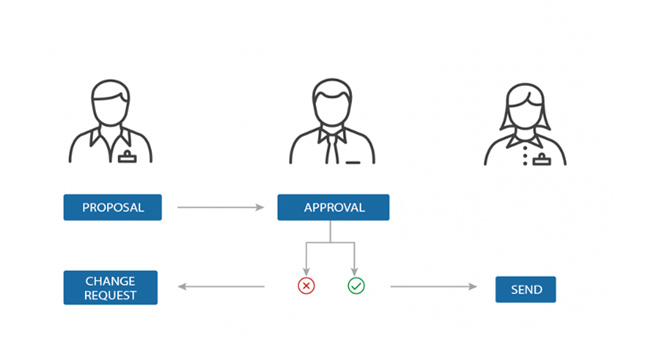
The word Workflow means “work stream” and is used to identify the digital model of a process through its rationalisation and division into different activities (tasks), with the aim of optimising performance and making efficient use of resources. Tasks may be automatic when they do not require decision-making intervention: it is possible to create a number of conditions (activation rules) that will automatically initiate a specific workflow, notifying the user or group involved that they have been assigned a new task to perform. Once the task has been completed, if the process so requires, the workflow will send a new task to the next user to take charge of the next step in the workflow.

Artificial Intelligence in Business Processes

Artificial Intelligence is ushering in a new generation of workflows, where documents, data, applications, and AI work together to support process execution and make business operations more effective and context-aware.

By integrating AI capabilities for document classification, information extraction, and content analysis, organizations can provide valuable insights to support decision-making and accelerate business processes.

AI capabilities can be invoked directly within workflows, leveraging information already available in the process, such as documents, attachments, operational notes, and variables, to perform actions that require data analysis and interpretation.

As a result, workflows go beyond automating repetitive tasks. They can unlock the value of corporate knowledge and delegate specific activities within the process to AI, enabling a higher level of efficiency and automation.

Document workflow

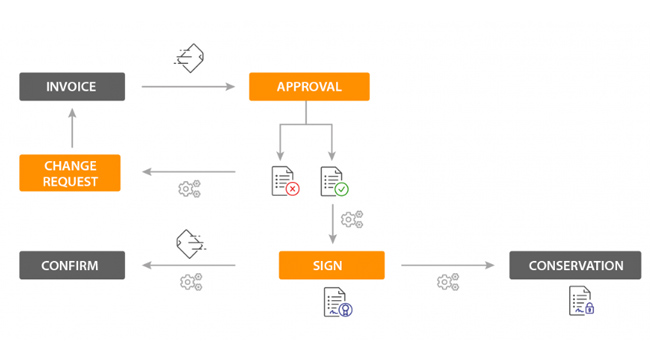
A document workflow is a standardised procedure by which a document can be acquired, created, signed, logged, modified and finally archived. The use of document workflows therefore allows each organisation to follow the life cycle of a document efficiently.

Document workflows

Workflow for process
management

As regulatory requirements, business procedures, and market demands become increasingly complex, the adoption of workflow automation has become standard practice for organizations of all sizes.

Workflows provide an essential framework for managing and optimizing business processes, helping organizations monitor performance, improve operational efficiency, and make the most effective use of resources.

Workflow by processes

AI-Powered workflows

The integration of Artificial Intelligence takes workflow automation to the next level.

While traditional workflows execute tasks based on predefined rules, generative AI leverages documents, data, and contextual information to support process execution and provide users with deeper insights and greater context.

In this scenario, documents are no longer simple inputs or outputs. Instead, they become an active component of the workflow itself, helping drive decisions, actions, and outcomes throughout the process.

Discover more here

Elements of Workflow Diagrams

A workflow is the description of a process by splitting it into several micro-tasks. Basically, a workflow consists of 3 main elements.

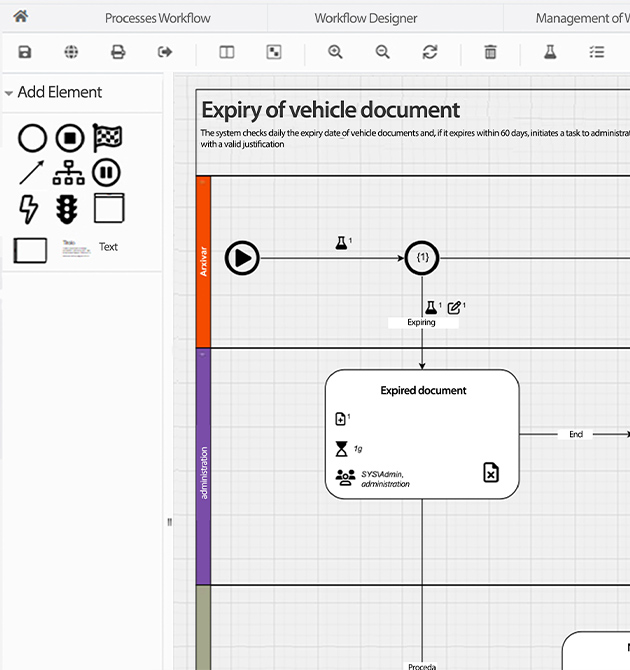
ARXivar Workflow Web Modeller

ARXivar’s graphical workflow modeller is tfully web-based and allows you to design and quickly get your company’s workflow management up in a drag-and-drop mode using a very simple interface that requires no programming skills. This extremely versatile and user-friendly tool adapts to the needs of any company and its business processes.

How to create a document workflow in 3 simple steps with ARXivar:

  1. Mapping Workflows
  2. Drawing Workflows
  3. Monitoring Processes
Workflow Web Modeller

Workflow Use Cases

Load More